
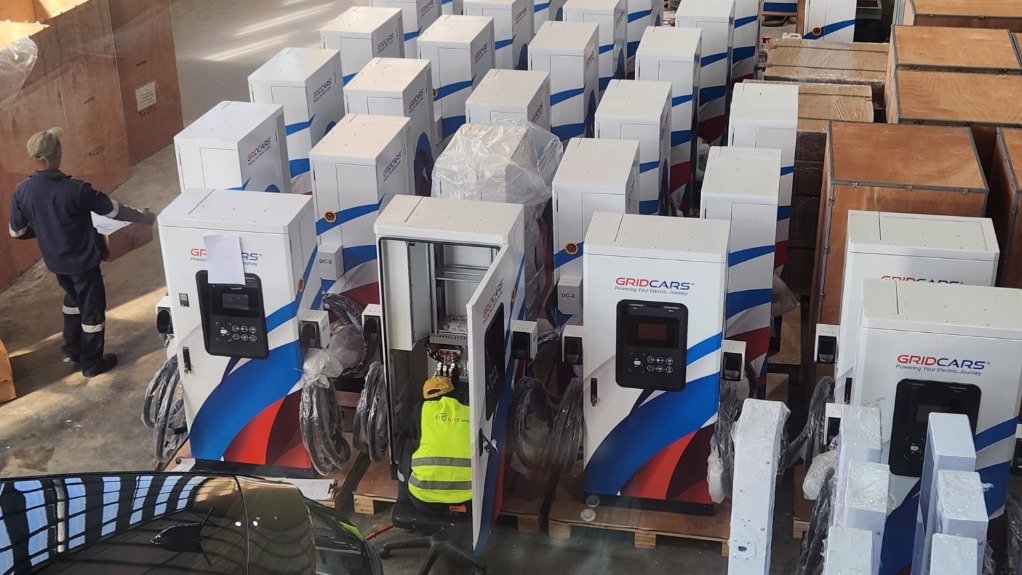
There is a strange feeling that comes with seeing one of our original GridCars chargers standing in the warehouse after being removed from service.
To most people, it is simply old equipment. To me, it represents the beginning of electric mobility in South Africa.
These chargers supported some of the country’s earliest EV drivers, helped manufacturers launch electric cars into an uncertain market and enabled journeys that would otherwise not have been possible. Some served motorists for more than a decade.
It is difficult not to feel a little sad when they are removed. I believe we should preserve some in a museum. They are part of South Africa’s EV history.
We started before the market was obvious
My journey into electric mobility began by converting vehicles to electric drive.
Working directly with the technology convinced me that EVs were not a passing trend. I could see the continuous improvement in batteries, motors and power electronics, and I became convinced that the future of transport would be electric.
At the time, very few people agreed. There were almost no EVs in South Africa and virtually no public charging infrastructure.
I had to decide where GridCars could make the greatest contribution.
We were not going to become a vehicle manufacturer. But building the infrastructure that could give manufacturers and motorists confidence in EVs was within our ability.
The part we could play was not designing the cars.
It was building the network.
Somebody had to move first
The early market presented an obvious problem: how could we justify installing chargers when there were hardly any vehicles to use them?
But why would anyone bring or buy an EV if there was nowhere to charge?
GridCars chose to build ahead of demand.
We followed a coverage strategy, not a short-term utilisation strategy. Our goal was to make South Africa’s routes accessible to EVs, even when individual sites could not yet be profitable.
Within a relatively short period, we had covered more than 4,000 kilometres of major highways.
Those chargers created confidence. They showed drivers that long-distance travel was possible and gave manufacturers a credible foundation for launching EVs locally.
I believe GridCars created the infrastructure foundation for EV adoption in South Africa.
When 110 kilometres felt like a long way
One of my clearest memories is driving a BMW i3 launch vehicle between charging stations to test the network.
Its range was around 110 kilometres.
Every trip had to be planned carefully. Distance, terrain, weather and charger availability all mattered.
When your vehicle has 110 kilometres of range, the next charger is not simply an electrical cabinet. It is the difference between completing the journey and not completing it.
That experience still shapes how GridCars works. We do not see a network as a collection of machines, but as a service drivers must be able to trust.
Industry support followed
BMW became the first major automotive company to support the GridCars mission in 2013. Later, with the Jaguar I-PACE launch, GridCars deployed around 40 Jaguar-branded DC charging sites.
For me, this showed that GridCars was being taken seriously as a national charging network developer. The industry was beginning to recognise that vehicles and infrastructure had to develop together.
The original network did its job
Today, some of those early chargers are being replaced.
Not because the original vision failed, but because it succeeded.
The vehicles entering the market now are very different from those we tested a decade ago. Batteries are larger, charging speeds are increasing, voltage architectures are changing and customer expectations are higher.
The market is also expanding beyond passenger cars. Delivery fleets, commercial vehicles, buses and electric trucks require more capacity, better access and different site layouts.
Refreshing the network is therefore not simply about replacing one charger with another. It is about preparing proven locations for the next decade of electric mobility.
Investing boldly again
GridCars now has new shareholders, renewed energy and a strong commitment to building on the legacy that began in 2009.
The South African EV market is showing real growth. More manufacturers are introducing vehicles and commercial fleets are planning their transition.
This is the right time for GridCars to invest boldly again.
We are refreshing selected parts of the national network while continuing to develop new sites, strengthen key routes and prepare infrastructure for a broader range of vehicles.
The detailed technology behind the next generation of GridCars chargers deserves its own article. For me, the bigger story is the decision to invest again.
The principle that guided us in the beginning remains true:
Infrastructure cannot wait until every vehicle is already on the road.
Proud of the past, ready for the future
GridCars has gained something that cannot be created by importing a charger or launching an application.
We have experience.
We know how to identify locations, plan routes, engage property owners, design installations, integrate equipment, commission sites and operate a network over many years.
We do not only supply chargers.
We develop networks.
I am proud that GridCars acted when the EV future was not yet obvious. I am proud that we invested in national coverage before it was commercially attractive. And I am proud of the people who installed, monitored, maintained and supported the network.
Seeing our original chargers return to the warehouse is emotional. They represent belief, risk, persistence and thousands of journeys made possible.
Perhaps some really do belong in a museum.
But while we preserve the history, our attention is firmly on what comes next.
The first generation of the GridCars network helped establish electric mobility in South Africa.
The next generation must enable it at scale.
- Winstone Jordaan, CEO, GridCars